
As organizations grow through mergers, acquisitions, regulatory requirements, or business segmentation, operating across multiple Microsoft 365 and Azure tenants becomes increasingly common.
While a multi-tenant architecture provides flexibility, it also introduces a significant challenge: maintaining a consistent and effective security posture across every environment.
Without a unified approach, security teams often face configuration drift, fragmented visibility, inconsistent policy enforcement, and operational inefficiencies that increase organizational risk.
Fortunately, Microsoft provides several native tools that help organizations standardize security operations across tenants while maintaining governance and compliance requirements.
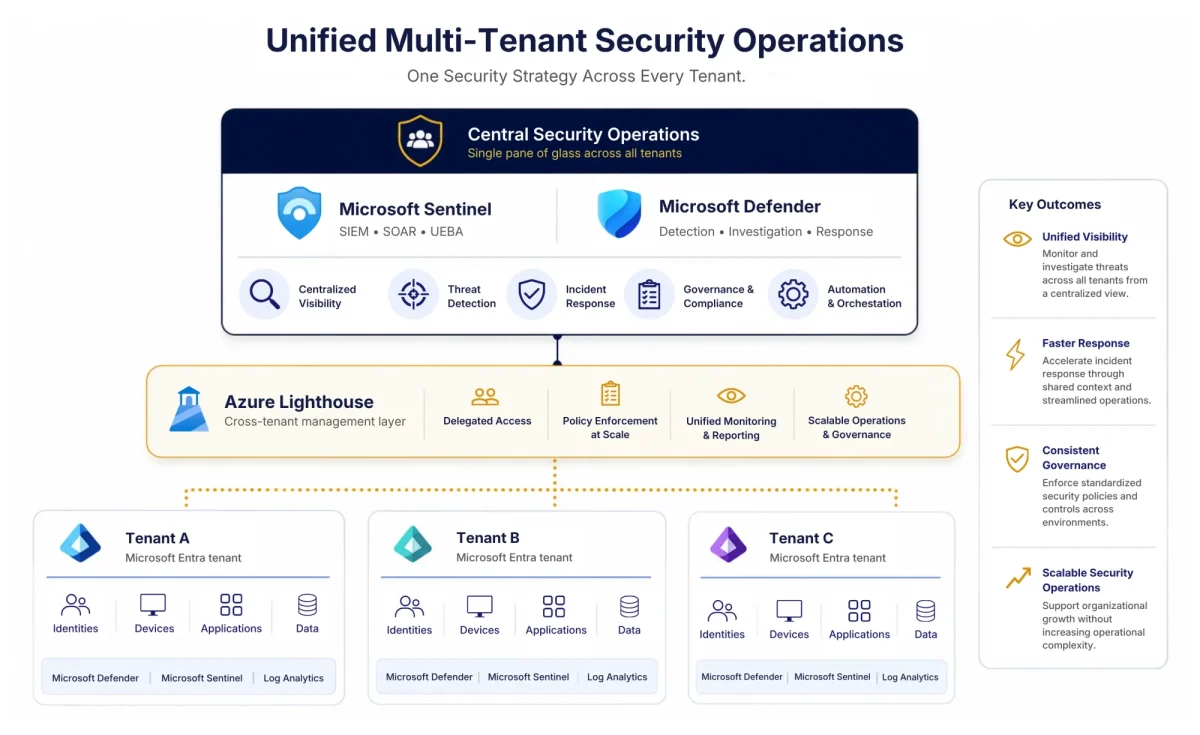
In this article, we’ll explore practical strategies for building a unified security posture using Microsoft Defender, Microsoft Sentinel, Azure Lighthouse, and Microsoft Entra ID.
Standardizing Security Operations Across Tenants
A strong security foundation begins with consistency.
When Microsoft Defender and Microsoft Sentinel are deployed differently across tenants, security teams can struggle with visibility gaps, inconsistent response procedures, and increased management overhead.
To reduce complexity and improve operational efficiency, organizations should focus on standardizing deployment and configuration practices across all environments.
Establish Baseline Security Configurations
Azure Policy and Microsoft Security Baselines provide an effective way to enforce consistent security settings across tenants.
These baselines help ensure critical controls remain aligned, including:
- Endpoint Detection and Response (EDR)
- Antivirus (AV) configurations
- Attack Surface Reduction (ASR) rules
- Security monitoring settings
By defining and enforcing standardized configurations, organizations can reduce security drift and improve compliance across environments.
Centralize Security Visibility
Security teams are only as effective as the visibility they have.
Forwarding logs from Defender and Sentinel instances into a centralized Microsoft Sentinel workspace enables teams to monitor threats across all tenants from a single location.
Organizations can accomplish this through:
- Cross-workspace data connectors
- Azure Monitor integrations
- Centralized security analytics and reporting
This approach helps eliminate security silos and improves detection capabilities across the enterprise.
Automate Incident Response
Manual processes become increasingly difficult to manage as tenant counts grow.
Leveraging Azure Logic Apps and Azure Functions enables organizations to automate incident triage, alert enrichment, and response actions across multiple tenants.
Automation not only reduces response times but also helps ensure consistent handling of security incidents regardless of where they originate.
Enabling Scalable Cross-Tenant Management
Technology standardization alone is not enough.
Organizations also need a management framework that allows security teams to operate efficiently across tenant boundaries.
This is where Azure Lighthouse, Management Groups, and Cross-Tenant Access settings play a critical role.
Azure Lighthouse
Azure Lighthouse provides secure delegated resource management across multiple tenants.
This capability allows internal security teams or managed service providers to:
- Apply governance policies
- Monitor resources
- Investigate threats
- Perform incident response activities
All without requiring administrators to constantly switch between tenants.
For organizations managing complex environments, Lighthouse becomes a key enabler of operational scale.
Management Groups
Although Azure Management Groups operate within a single tenant, they remain an important governance tool.
They help organizations:
- Standardize policy enforcement
- Organize subscriptions
- Maintain compliance requirements
When combined with Azure Lighthouse, Management Groups contribute to a broader governance strategy across the entire tenant ecosystem.
Cross-Tenant Access Settings
Microsoft Entra ID Cross-Tenant Access settings allow organizations to establish trusted relationships between tenants.
These configurations support:
- Secure collaboration
- Identity governance
- Shared service models
- Cross-tenant incident response
This capability is particularly valuable when multiple business units or acquired organizations must work together while maintaining separate tenant boundaries.
Lessons Learned from Real-World Implementations
Organizations that implement unified security operations across multiple tenants often discover that technology alone is only part of the solution.
Several recurring lessons emerge during deployment and ongoing operations.
1. Policy Drift Happens Faster Than Expected
Without continuous monitoring and automated enforcement, security configurations naturally begin to diverge.
Using Azure Policy and Microsoft Defender for Cloud recommendations helps organizations identify and remediate configuration drift before it becomes a security risk.
2. Collaboration Requires Clear Ownership
Cross-tenant security operations often involve multiple teams, stakeholders, and business units.
Clearly defining roles and responsibilities is essential.
Role-Based Access Control (RBAC) and Privileged Identity Management (PIM) help enforce least-privilege access while providing accountability across teams.
3. Incident Response Must Extend Beyond Tenant Boundaries
Threat actors do not respect organizational structures.
Security playbooks should be designed to operate across tenants and provide visibility into alerts, incidents, and logs regardless of where activity occurs.
A federated incident response model improves coordination and reduces response times.
4. Training Remains a Critical Success Factor
Even the most advanced tools provide limited value if teams do not understand how to use them effectively.
Organizations should invest in training focused on:
- Azure Lighthouse
- Microsoft Sentinel multi-workspace capabilities
- Cross-tenant identity governance
- Centralized monitoring and response processes
Well-trained teams are essential for maintaining long-term operational success.t drowning in noise.
Final Thoughts
Building a unified security posture across multi-tenant environments is more than a technical initiative, it is a strategic requirement for modern enterprises.
By leveraging Microsoft-native capabilities such as Microsoft Defender, Microsoft Sentinel, Azure Lighthouse, and Microsoft Entra ID, organizations can improve visibility, strengthen governance, and create a scalable security model that supports growth without sacrificing control.
As multi-tenant environments continue to become the norm, organizations that invest in standardization, automation, and centralized security operations will be better positioned to manage risk and respond effectively to an evolving threat landscape.
Ready to Strengthen Your Multi-Tenant Security Strategy?
Managing security across multiple Microsoft 365 and Azure tenants requires more than technology, it requires the right governance model, visibility, and operational processes.
Bravo Consulting Group helps organizations design, implement, and optimize Microsoft security solutions that improve visibility, streamline operations, and strengthen security across complex environments.
Whether you’re navigating mergers and acquisitions, regulatory requirements, or organizational growth, our team can help you build a scalable and unified security strategy across your Microsoft ecosystem.
📅 Book a Strategy Conversation
📩 Prefer to reach out in writing? Submit the contact form.